
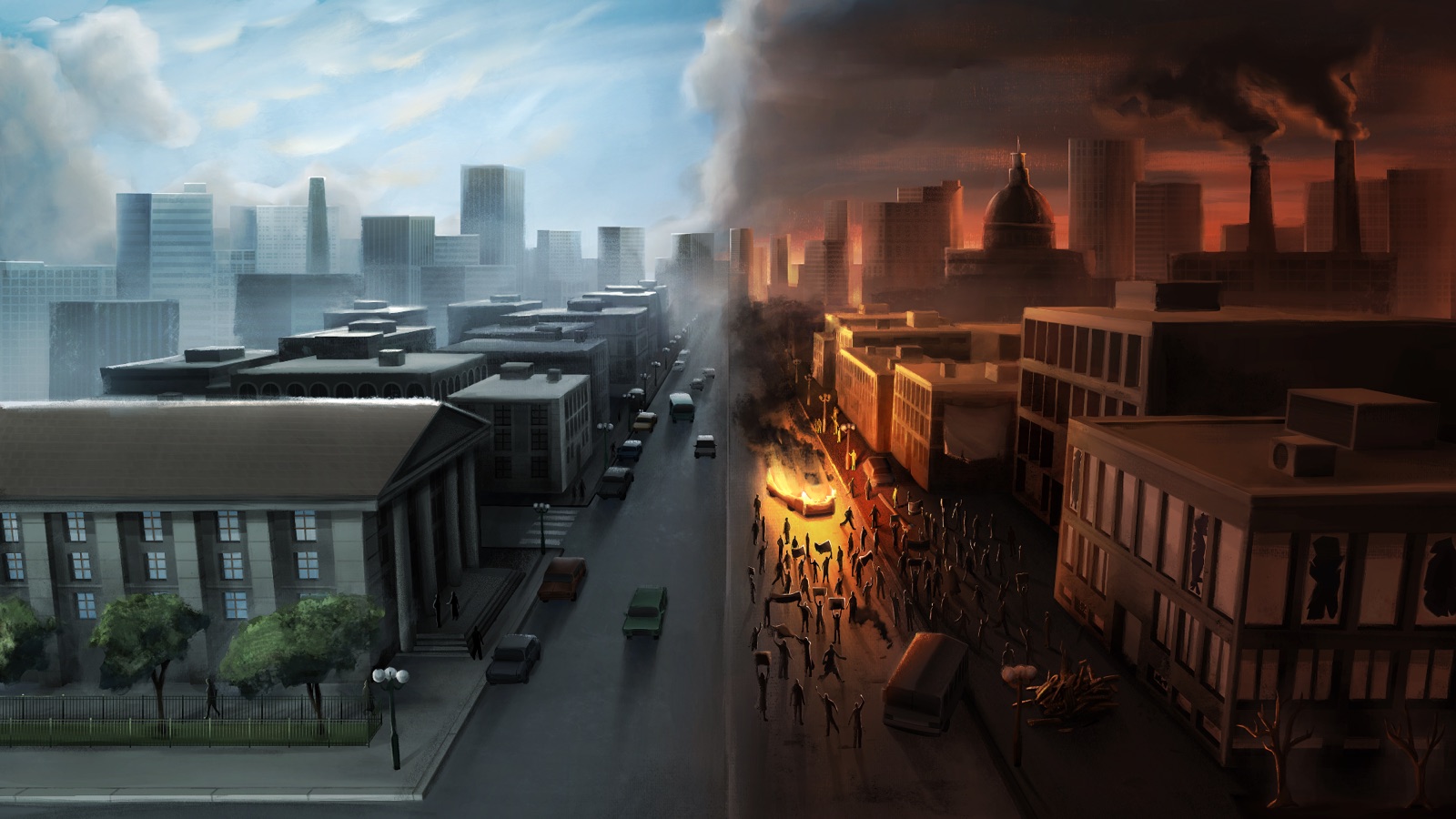

A city street split down the middle: orderly civic buildings and moving traffic on one side, a burning barricade and a crowd of protesters on the other.

In development

Turn-based political strategy

The game every politician should play before taking office.

Steam page

The store page is live. The game is in development and no release date is announced.

Step into the role of a national leader. Pass laws, sway public opinion, manage institutions, and hold a country together under pressure.

A packed hall in period dress cheering a speaker at a lectern beneath a large banner reading VICTORY, confetti falling from the ceiling.

The premise

Talk is over

Like many others, you have judged leaders from the safety of your screen, certain you had the answers. Now the power is yours: the economy, the people, the country itself. Talk is over. It is time to prove you were right.

A turn-based political strategy game about the complexities of modern governance. You take control of a nation and navigate policy management, international diplomacy, economic development and social reform, aiming for stability and success against dynamic events and competing interests.

  • Genre Turn-based political strategy
  • Platform PC (Steam)
  • Emphasis Realism, depth, replayability
Launch scenarios

Three countries, three impossible inboxes

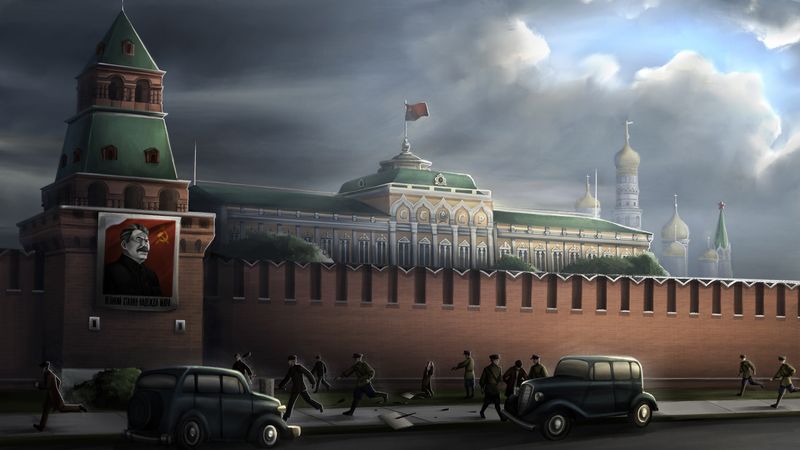
  • Moscow's Kremlin wall under heavy cloud, a portrait of Stalin mounted on the brickwork, and figures hurrying along the street below.

    USSR · 1953

    Rebuild an empire of fear and hope

    Joseph Stalin is dead. The Soviet Union stands frozen between fear of the past and hope for the future.

    Policy runs through the State Planning Committee.

  • A suburban American street in bright daylight: a picket fence, a woman watering plants at a clapboard house, and a newspaper boy reading a headline.

    United States · 1955

    Lead the western superpower

    The United States stands at the height of its power, with prosperity, civil rights and Cold War tensions pulling in different directions.

    Policy runs through a Department of State.

  • A Japanese street at sunset: traditional tiled roofs on one side, factory chimneys smoking behind, and a steel building frame going up beside a crane.

    Japan · 1952

    Rise from the ashes of defeat

    Japan has regained its sovereignty. Reconstruction, reform, tradition, scarcity and security all compete for attention.

    Ministries are mapped to the real ones of the period.

Policy categories map to real ministries per country, so the same decision is routed through the Soviet State Planning Committee in one scenario and a Department of State in another.

Governance and policy

Nothing passes because you want it to

Propose, negotiate and pass policies across economic, social, foreign-relations and environmental categories. Policies need approval from governing bodies depending on their type and scope.

Every one of them has to be balanced against GDP, public happiness, environmental health and national stability. There is no policy that improves all four.

The four governing bodies

Legislative, Executive, Judiciary and Symbolic. Each carries its own voting power, approval threshold and party-faction dynamics, and which of them a policy has to pass through depends on that policy's type and scope.

You can reform the structures themselves by changing legislative composition, or abolishing symbolic roles outright, so a long campaign can end up governing through a structure that no longer resembles the one it inherited.

Parties, factions and citizens

Nobody is only one thing

Citizens belong to multiple overlapping groups. That single decision is what stops the population from behaving like a single opinion poll.

How overlapping citizen groups produce composite identities Citizens hold membership in several groups at once, such as Socialists, Capitalists, Motorists and Environmentalists. Overlapping memberships combine into composite identities such as a Working-Class Environmentalist or a Wealthy Industrialist, each of which reacts to the same policy differently. Relationships with each faction move on a scale from zero to one hundred. CITIZEN GROUPS Socialists Capitalists Motorists Environmentalists COMPOSITE IDENTITIES Working-Class Environmentalist Wealthy Industrialist Same policy, different reaction Same policy, different reaction 0 100 RELATIONSHIP WITH EACH FACTION
A "Working-Class Environmentalist" and a "Wealthy Industrialist" are not two slots on a left-right axis; they are two different combinations of memberships, and they respond to the same law in different directions. Relationships with factions move on a 0– 100 scale.

Parties

Nations contain parties with their own stances: conservative, progressive, nationalist. They can form alliances, stage protests, or simply obstruct everything you put in front of them.

Elections

Election cycles where voter support decides the outcome, driven by economic performance, social reforms, scandals and international relations. Campaign strategies, coalitions and compromises are all available to hold power.

Economy and crises

The budget is the argument

Economy

A detailed simulation of revenue, expenditure, trade and debt.

Budget allocation
Healthcare, education, military, infrastructure
Levers
Taxation and trade policy, moving GDP growth, unemployment and public happiness

Crises

Rapid decisions that trade short-term cost against long-term benefit.

Forms
Natural disasters, economic recessions, social unrest, geopolitical conflicts
Pressure
They arrive while the rest of the agenda is still open

How the country talks back

Dashboards cover GDP, approval ratings, public happiness, environmental health and international standing, down to the satisfaction of individual citizen subgroups. A simulated media system broadcasts headlines, polls and faction reactions.

Contextual alerts surface protests, alliances, economic milestones and crises with the consequences spelled out. A Timeline of Leadership records major decisions, policy outcomes and global events, so a run can be reviewed afterwards and shared.

Each scenario has explicit victory and failure conditions, and ends with a performance rating and a breakdown.

HoruSphere Interactive Presentation In development

The main menu is a newspaper

Bold type, two facing pages, and a turn of the page between them

The presentation is the identity. Not a menu with a newspaper texture behind it: a newspaper you operate.


The main menu is styled as a real newspaper: bold, clean newspaper typography, two facing pages, and page transitions between them. It sets the register before a single policy has been proposed, and it makes the media system in the game feel like part of the same object rather than a separate screen.

The trailer holds the same line. The tone is cold and documentary-like, narrated in a detached radio-narrator voice, global in scope, punctuated with bold red-and-grey typewriter title cards.

That period-press treatment is why the three launch scenarios sit where they do. A newspaper from 1953 Moscow, 1955 Washington or 1952 Tokyo carries its own assumptions on the front page, and the interface is happy to inherit them.

It also solves a real problem for a strategy game with this much on screen. Newspaper layout is a solved discipline for ranking dense information, headline, dek, column, caption, and borrowing it means the player reads the state of a nation the way they would read a broadsheet.

Trailer

Cold, documentary, global

If the embed does not load, watch it on YouTube.

Planned directions

Where we want to take it after launch

Planned, not promised, and not dated. Listed so you can see the shape of the ambition rather than guess at it.

  • Constitutional reforms
  • AI-driven opponent leaders
  • Deeper political party management
  • Procedural lawmaking
  • Modding support
  • Military and defence mechanics
  • Expanded diplomacy and treaties
  • Population demographics and migration
  • Intelligence and espionage
  • Additional historical, fictional and modern scenarios

Procedural lawmaking means drafting, committee hearings, debates and roll-call votes: the part of governing that happens before anyone gets to vote yes.